Ocean Trestles: Funchal Pilings
When an island aerodrome cannot expand due to sheer oceanic drop-offs, civil aviation engineers are forced to abandon land reclamation and construct massive structural bridge platforms over open water. Madeira's Cristiano Ronaldo International Airport stands as one of civil engineering's most daring feats.
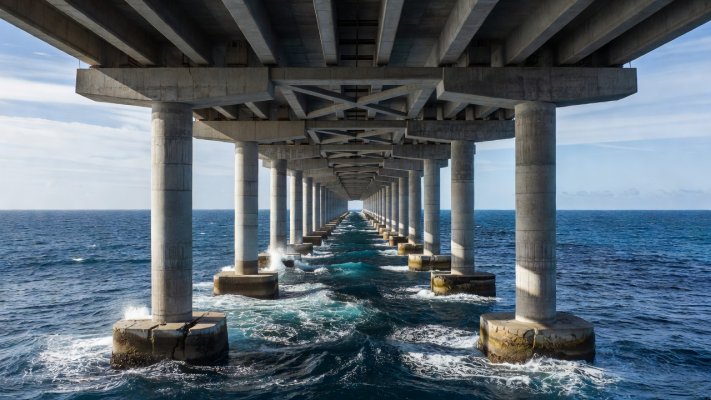
The 180 Pillar Engineering Feat
Originally constructed in 1964 with an infamously short 1,600-meter strip, Madeira Airport (LPMA) was hemmed in by steep volcanic cliffs on one side and a 50-meter plunge into the Atlantic on the other. Following tragic overrun incidents in the late 1970s, the regional government initiated an audacious structural expansion completed in 2000.
Engineers constructed a 1,020-meter bridge deck supported by 180 reinforced concrete columns, each up to 3 meters in diameter and rising up to 70 meters from the shoreline and seabed. The bridge deck handles full touchdown impact loads of widebody jets such as the Boeing 777-200 and Airbus A330, absorbing massive dynamic kinetic energy while seawater crashes against the foundations below.
The Aerodynamic Rotor Challenge
While the bridge solved the runway length deficit (expanding TORA to 2,781 meters), it could not alter the island's extreme meteorological hazards. Madeira’s volcanic mass acts as a colossal wedge against the northeast trade winds.
As air passes over the mountain peaks, it tumbles down the leeward slopes, creating invisible rotating cylinders of air known as mechanical rotors. Pilots on visual approach to Runway 05 encounter smooth air until 500 feet above the water, where sudden downdrafts and 30-knot crosswind shears strike the airframe simultaneously.
LPMA Approach Parameters
- Pavement Elevation: 190 ft MSL
- Approach Type: Visual Curving Approach to RWY 05
- Crosswind Limit for Operations: Max 15 kts gusting 25 kts (strictly enforced)
- Go-Around Decision Altitude: 480 ft AGL (Instant throttle-up to sea)
Saba: The Aircraft Carrier of the Caribbean
In the Caribbean, Juancho E. Yrausquin Airport (TNCS) on the island of Saba takes marine vulnerability to an absolute extreme. With a total length of 400 meters (1,312 ft), it is recognized as having the shortest commercial paved runway in the world.
Perched on a flat rock outcropping jutting from a volcanic peak, both ends of the runway terminate in vertical cliffs dropping directly into the ocean. There is no overrun area, no arresting gear, and no space for instrument landing antennas. Only STOL (Short Takeoff and Landing) aircraft like the BN-2 Islander and Twin Otter are certified to touch down, piloted by crews who treat every approach with the precision of a naval carrier trap.
Aeronautical Classification
Madeira and Saba are both classified by aviation regulators as Category C airfields. Captains must perform specialized computer simulator training replicating the exact wind shear profiles and visual dogleg approach paths. Furthermore, if a captain has not operated into Madeira within the previous 12 months, a line check with an examiner is legally required prior to carrying passengers.
Explore Polar Surface Friction
From warm tropical waters to sub-zero polar pack ice, explore how flight crews manage zero-friction landings on Antarctic blue ice shelves.
Read Polar Ice Technical Analysis